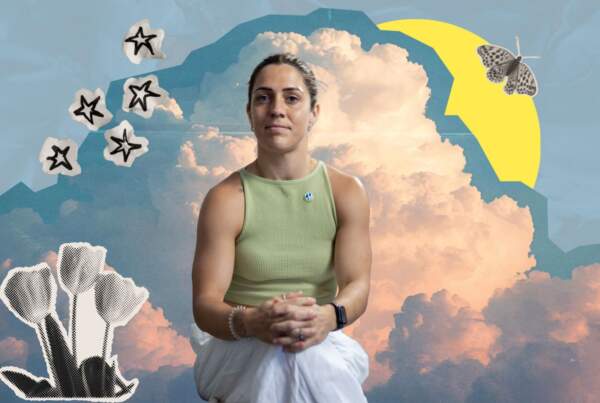

Interview of Alexa Leary by Freya Bennett // photograph by Paul Harris
Alexa Leary’s story is one of life split in two: before and after a catastrophic cycling accident in 2021 that left her with a severe traumatic brain injury and an entirely changed future. Once a rising triathlete, she now reflects on rebuilding her identity from the ground up. From learning to live with a new brain, a new body, to exploring a whole new sense of self. Spanning hospital rooms, family memories, and her return to elite sport as a Paralympic gold medallist, her journey is at once confronting and full of determination. Through it all, Lex holds onto the same instinct that carried her through her recovery: to keep moving forward, even when nothing feels the same.
 In Sink or Swim, you describe a life split into “before” and “after” your accident. When you look back now, how do you understand the person you were before that moment and how do you relate to her today?
I think before my accident I was still trying to figure myself out. I was searching for who I was and what I was hoping to achieve with my life. I don’t remember much of who I was in the years leading up to my accident because of my TBI, but from what I can understand from others is that I was pretty passionate about competing in triathlons and my career in sport was just taking off. I suppose I can still relate to her now because I have spent the last almost 5 years trying to figure myself and my new brain out again. I have had to learn all about myself and find my passions and what I wanted to get out of life. I’m also as passionate about sport now as I was back then, so I guess it was similar in that sense too.
Much of your recovery was spoken through the voices of your family, coaches, and doctors. How did it feel to reconstruct your story through other people’s memories when your own voice wasn’t always accessible?
It was pretty incredible to hear my story and recovery explained through the ones closest to me. It was actually really confronting to hear it all in their words. There were some parts that I had never heard before until I was finalising the book. That was quite difficult, but hearing it all from other peoples perspectives really paints a whole picture and gives me some understanding of what I went through and what others in my life had to go through while I was in the hospital.
There’s a strong theme of being misunderstood or unseen when it comes to traumatic brain injury. What do you most wish people understood about living with a TBI that they often don’t?
I want people to know that TBI’s are not something that are easy to live with. It may look like I’m ok now, but it’s a constant battle every day. People with TBI’s suffer with severe mood changes, memory loss, difficulty sleeping as well as depression and anxiety. It’s an invisible disability and some people don’t understand the effects it has day to day. I do hope that over time, people can become more understanding and have more acceptance for those with a TBI.
The MoveForLex campaign turned your recovery into a collective movement. At what point did you realise your personal rehabilitation had become something that was resonating far beyond you?
I didn’t really know the in’s and outs of MoveForLex until I was home from the hospital. My family told me that when I was in the hospital they would show me videos and kind messages of support on the page and my face used to light up. I think the page was some light within such a dark time. When I was able to comprehend it a bit more, it felt truly incredible that there was such a movement around getting out and moving for people who couldn’t. Spreading that much positivity I know helped my family so much through the most difficult time in their life, and I hoped it brought some hope for other people that may have been going through something similar.
Sport clearly became part of your second life. What does swimming give you now that feels different from the version of sport you knew before your accident?
I feel like swimming now gives me purpose. When I came home from the hospital, my life had completely changed. I had lost most of what my life was like before the accident. I needed to have something to strive towards, to do something for myself. Swimming absolutely became that.
You’ve achieved extraordinary success since your injury, including Paralympic gold. How do you personally hold those achievements alongside the ongoing realities of recovery and identity after brain injury?
It can take me time to process the achievements I have made. It feels amazing to know that I was able to defy the odds by winning gold at the Paralympics. It really just shows that no matter what you have gone through, you can come out the other side, if you are willing and open to giving life a good crack. Life with a TBI is up and down. There are good days and bad days. But, I am so proud that along with the struggles I face daily, there are achievements that I have made that make me feel like I can combat anything.
If someone who has never encountered a hidden disability reads Sink or Swim, what is the one feeling or understanding you most hope they leave with?
I want them to know that they are not alone. I want them to know that life does get better and the bad things that happen to us do not define who we are. I hope people can walk away with the determination to keep going and pushing forward.
Sink or Swim is out now in all good bookstores.