
Interview with Chloe Petts by Phoebe O’Brien and Rachel Iampolski
Chloe Petts is in Melbourne for the International Comedy Festival with her fourth solo show, Big Naturals, and we meet up for a coffee and (some ridiculously tiny cookies) to learn more. “I know this is a feminist magazine”, Chloe warns us jokingly, “but don’t be fooled it’s actually a very woke show despite being named after big fat juicy tits”. Specifically, she explains, it is about “growing up on lad culture” and the effect it had on her: “I’m kind of taking a bit of an irreverent look at it,” she says, “and talking about how fun and intoxicating a lot of the elements of them are, but actually maybe when it comes to more substantial things like being able to process your feelings, maybe it’s not the best thing at all.”
Part of what gives the show its charge is that Petts is not especially interested in talking about lad culture as something external to her, like a bad set of ideas belonging to some ‘other’ tribe. Instead, she is honest about her affections for its atmosphere: “I don’t enjoy lad culture,” she says, “but I enjoy the things where lad culture happens. I love going to see Kasabian, I love Oasis, I love going to the football. What do you do if you’re not a lad, but you love laddy things?”
With a name like Big Naturals, we end up talking about the old newsagency experience of seeing topless women splashed across newspapers and lads’ mags — and how as youngsters this felt both thrilling and transgressive, almost illegal. The show begins with a discussion of ‘Page Three’, a British tabloid feature where the third page carried a topless glamour model. It seems almost quaint in retrospect now; a limited, visible form of sexism replaced by the internet’s endless, far more pervasive stream of content about women’s bodies. Chloe proposes a solution, suggesting we “delete the internet but print everything out and then put it back on the newsagents,” so anyone wanting to consume that material would once again have to “slide a quid across the counter” and look somebody in the eye.
Watching the show, and in chatting with Chloe, we get a crash course in lad culture. She gives an example from an old Radio 4 project she worked on, on the history of toilets. When public toilets for women were first introduced in Victorian England, she explains, they were designed so women would stay out longer and therefore spend more of their husbands’ money. But men were so outraged by the sight of women occupying public space for longer that they would “accidentally crash their cars into them.” She half jokes: “that’s just lad culture.”
We discuss the internet’s role in shaping lad culture, and Petts is careful not to lean too heavily on fashionable language, even when discussing the manosphere. “There’s a more toxic side of the internet,” she says, “where they’re able to position themselves as underdogs — ‘no one’s saying this stuff anymore’ — when actually they’re still kind of the mainstream.” Because culture is now so atomised, she argues, those ideas can find ever more specialised audiences and push themselves into stranger, harsher forms. Still, she resists despair, buoyed by the fact that history is a pendulum. Lad culture itself was, in her view, a backlash to third-wave feminism; the present moment is another swing in the same cycle, this time in response to Me Too and the gains women and minorities have made. “We’re overdue for another swing towards equality,” she says. “We’ll get there again.”
Despite the political context of her work and topic area, the strength of her voice comes from being able to discuss the subject with both irreverence and care at the same time, in spite of what people might project onto her. “A lot of people think my stuff is overtly political because they interpret my identity as political,” she says. “But there’s nothing political really about what I’m saying.” She does so even when it gets hard: “I’ve never really code-switched,” she says. “I’ve always just gone into a space and tried to be myself — and then sometimes if that doesn’t work I just go very quiet.”
We saw that irreverence and care in action, when one night midway through her performance a man (a lad, one might say) threw a Mars Bar at Petts. One could have cut the tension in the room with a knife, and as an audience member (who generally isn’t as forgiving of lads), we were mad. But Chloe met the situation with an expert cool detachment, humour and even empathy. “He just didn’t [know not to throw it],” she reflects, and saw it as a teaching moment. “When the Mars Bar hit me I was a bit like… I find this funny, but also I do need to set a boundary with this man”. She seems pleasantly surprised when we point out that, in handling the interruption, she more or less acted out one of the show’s own lessons and central themes — diffusing conflict exactly as she describes her father doing. Life, for a moment, had slipped into the logic of the set.
Petts is very good on this kind of live, unstable audience energy, walking the thin line between inclusion and chaos. Yet she remains tender about audiences, reflecting that she assumes that anyone coming to her show is a nice person, or at least an open-minded one, simply by virtue of having chosen to be there and accepting her. She sees this as a privilege. Even the idea that she might have drifted into an educational or representational role is one she meets with a kind of bemused practicality: if people listen to you because you have a microphone, all you can really do is speak honestly and hope that helps.
Interestingly, since becoming a professional comedian her relationship with comedy has taken a different form. Petts reflects that she “doesn’t really understand what it feels like to be an audience anymore,” and that “there’s a distance to it now.” When she watches even her favourite comedians, she can see the mechanics of the show, where before she couldn’t, and that it’s something one can’t unsee.
Despite this, Petts was not a stand-up obsessive growing up. There were no comedy heroes in the house, or a comedy canon to learn about. She learned about comedy watching what was on television: The Vicar of Dibley, Outnumbered, Miranda. The first stand-up she remembers really watching was Michael McIntyre and Rhod Gilbert on Live at the Apollo. “I think I kind of like it that way round,” she says now, because it meant she never copied anyone. “I never had any heroes or influences. So it was like I just did what I thought was right and I think that probably helped me.”
At fourteen, her teacher recommended she try stand-up, but she first pursued acting. Stand-up eventually came, not because she loved it at first, but almost in spite of that. “I can’t believe I carried on,” she says. “I hated it.” For the first couple of years she was nervous for two days before every gig, convinced she would be found out. What kept her going, more than some grand artistic certainty, was friendship, routine, and gamifying the experience by making herself do two gigs a week. She reflects how confidence did not precede the work, it emerged slowly out of repetition and community.
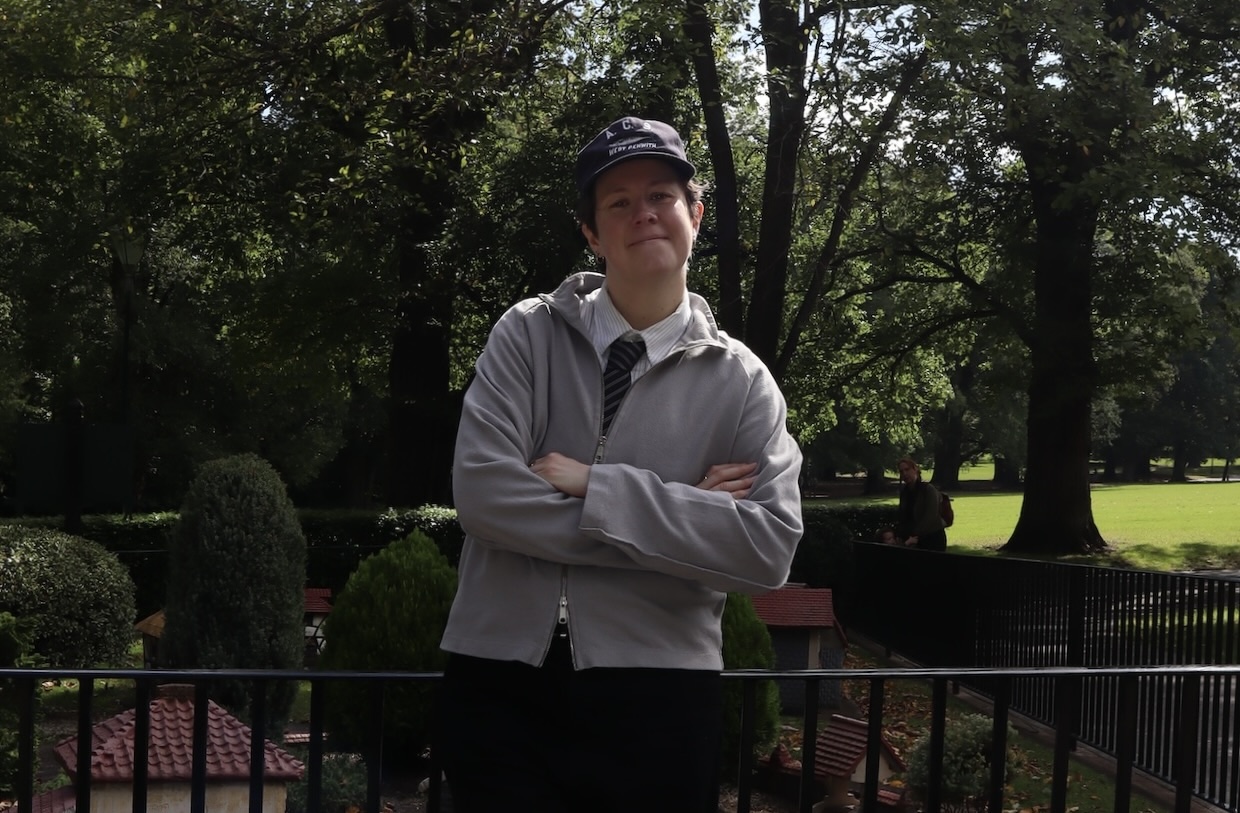
After coffee, we take a walk with Petts through Fitzroy Gardens to the Tudor Village — the miniature English hamlet gifted to Melbourne from England. England, Petts jokes, looked at Australia and decided: “we know what you need, it’s mini England. You’re welcome!” We discuss how Britain and Australia have a similar humour and more similarity than we care to admit: “I think we’re equally as feral as a nation but in different ways” she jokes. She loves Melbourne with the fervour of a seasoned return visitor and seems genuinely scandalised that its residents do not appreciate it enough. “You live in the best city in the world,” she tells audiences, to their occasional indifference.
While in Melbourne her show is on late, so she has time to build a whole evening before stepping onstage, which often includes time spent on Youtube. She jokes that her YouTube algorithm currently resembles that of a twelve-year-old boy: football streamers, Harry Styles, exercise videos, and the occasional stray algorithmic nudge toward manosphere sludge. She speaks with the same affection about Twitch brothers arguing over FIFA as she does about theatre, church, or Kasabian at Wembley. What she seems to love, over and over, is the strange dignity of people being fully, loudly into something.
Which brings us back to lad culture. Petts is a huge fan of collective experiences one can enjoy with their full chest (no pun intended): football chants, stadium singalongs at an Oasis concert, churches (she used to be in her church band), musicals, all those moments when a room or crowd coheres around something larger than itself.
That affection for the rituals of laddishness extends to her time in Melbourne too. Petts says that, deprived of UK football hours, she has been getting her “lad fix” at AFL games instead. “My team is Richmond (Go Tigers),” she says, before adding, with characteristic sincerity, that she does not really think sport is something that should be won so much as enjoyed. Still, some habits die hard. Used to the more combustible dynamics of English football crowds, she finds herself at the footy “sat there with a beer, trying to kick off the away fans, but no one will rise to my bait.” “I’m missing it,” she says. “I’m jonesing for a fight.” We laugh.
By the end of the conversation, what emerges is a portrait of a comedian with an unusually good ear for contradiction and an unusually steady sense of self within it. Chloe Petts is interested in laddishness without endorsing it, in politics without becoming didactic, in audience intimacy without losing control of the room. She has a comic’s instinct for playing around with earnestness, but not for retreating from feeling altogether. What she offers, onstage and off, is something subtler: a way of staying recognisably yourself inside spaces that were not built for you, and finding the joke there without pretending the tension is not real. Which seems, in its own way, a decent rule for life. And, for avoidance of doubt, so does this one: don’t throw a Mars Bar at Chloe Petts.
Chloe Petts’ Big Naturals runs at the Melbourne International Comedy Festival until 19 April. Tickets and session details here.