
Words by Clara Brack
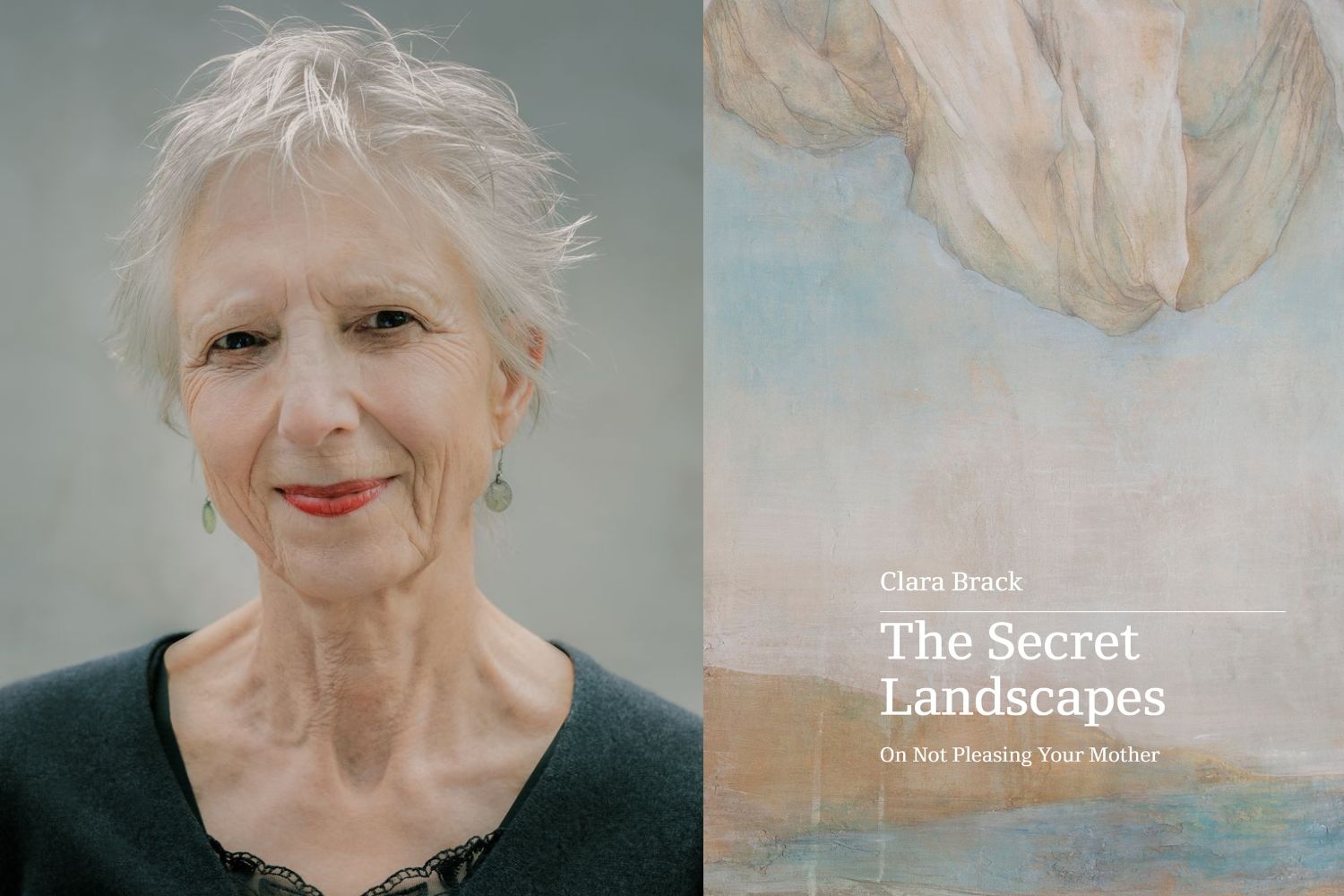 My book The Secret Landscapes will be published in April. It is my experience as the daughter of artists John Brack and Helen Maudsley. I am one of four daughters. We sometimes wondered what it would be like if there was a boy in our family. Curious to know what this would be like, I invented a fictional scenario where my father has a son from an affair with a dancer who has defected from the Ballets Russe. He writes letters to his son telling him about his childhood, his paintings and what has inspired them.
Unable to sustain this scenario I created another. My father talks to a therapist about his childhood. In writing his encounters with the therapist I explore my experience of my father as a troubled man. I tell of his relationship to me, my sisters and my mother, of his undermining, ‘you fat head, you dope, you idiot’. I come to understand that my father’s belittling of his wife and children arose from his form of self medication, his self disgust, his self loathing.
Others had different perspectives on my father as an artist and a teacher. Sometimes, on discovering that I was the daughter of John Brack, friends or acquaintances would bring me a treasured piece of crumpled paper, showing me a paragraph in Dad’s handwriting ‘Rod/ Peter has promise as an artist, has talent…’ When my father died fellow artists and former students were quoted in the newspaper saying what a magnificent artist, a wonderful teacher, reporting on the support and encouragement he gave them.
In writing the dialogue between my father and his fictional therapist I drew on what my father had said in interview with Sasha Grishin quoted in his book The Art of John Brack. As the book was nearing publication I emailed Sasha telling him about my forthcoming book and briefly what it was about.
A few days later I received a reply:
“Writing a monograph on an artist’s work is a very different exercise to writing about a person’s biography. . . many people have different facades when it comes to other people.”
He says that he is not conscious of it but “many people have told me that I appear to be a different person when I am speaking Russian from the person speaking in English.”
Then I read this:
“Your father, for me, was an incredibly kind person,”
Stunned, I read on.
“I think about the number of times he would go down to Camberwell and buy for me a bottle of Noilly Prat extra dry vermouth, when I was coming round, simply because I couldn’t stand whiskey. He selected passages of poetry, esp Philip Larkin, that he wanted to discuss with me and would bring out paintings to talk about. This had nothing to do with our book and continued after the book was published. He showed me a great generosity of spirit and I was surprised when some other people spoke of negative experiences with him.”
Aghast I took in ‘a great generosity of spirit’.
Then I read this.
“His biggest compliment was, when he said to me, ‘if I had a son, I would have liked him to be a bit like you.'”
I cried when I read Sasha’s email. Dad’s capacity for kindness. Sasha’s generosity in letting me know his experience of Dad’s kindness.
And then a disconcerting but reassuring sensation came over me. It was not so much that my world was falling apart but coming together. In the beginning of the book I had invented a fictional son, born to a Russian dancer. Now that the book was finished the real defacto son had announced himself. Not only that, he was Russian.
Then there was the serendipity of the timing. Sasha’s email had arrived two days before the final edits were due to be returned to the publisher. I wrote and asked Sasha’s permission to quote from his email in a postscript to the book. The account of my father’s undermining of his wife and children, was now followed by a paragraph with the statements ‘Your father, for me, was an incredibly kind person. He showed me a great generosity of spirit.’
Sasha had given me the final unexpected flourish to my book, the falling of the red velvet curtain: a declaration of how complex we are as human beings.