
Interview with Sarah Walker by Freya Bennett
Something wonderful has been happening to my bookshelf recently. Older women are finally getting to be the centre of the story and not in a neat or sentimental way. They are messy humans who have flaws and full stories to tell. In The Water Takes, Sarah gives us Pam: sharp, stubborn, funny, and so vividly drawn it feels like she’s lived a whole other life before the page.
Set in a world where puddles turn into sinkholes and nothing feels safe, the book pairs Pam with her young neighbour Charlotte, two very different people with a delicate relationship. Yes, the premise is dark, but somehow Sarah tells it without weighing you down. I felt strangely close to both of them by the end. Maybe because we’re all a bit of each: the guarded part, and the hopeful one. I chatted to Sarah about writing disaster, older women at the centre of stories, and how Pam and Charlotte came to life.
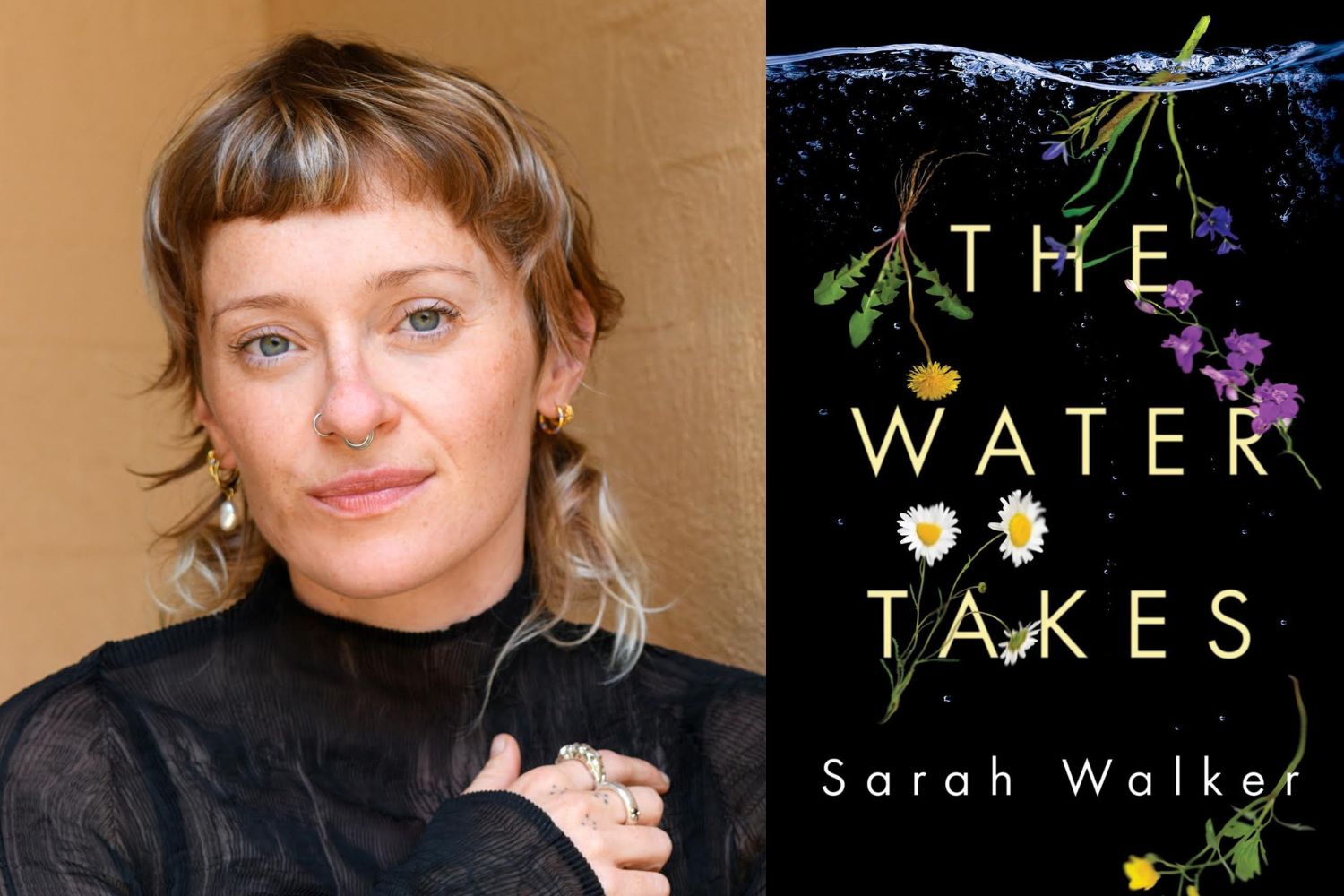 Hi Sarah, huge congratulations on The Water Takes, my new favourite book! How are you feeling now it’s out in the world?
It feels excellent! It’s such a wild thing, to dream up a world and all of the people in it. When it is finally released, variations of that world and those characters are being simultaneously created across many, many minds. There are so many Pams and Charlottes happening in peoples’ heads right now. What a marvel.
Can you tell us a bit about the process of writing this book? How long did it take and how many iterations of it were there?
I tend to work in spaced out, dedicated writing blocks of a month each. The first 30,000 words of the novel came in January 2022, and the next 30,000 about six months later. I was left with a heap of disparate scenes and loose threads. I was lucky enough to have a two-week residency at Varuna in early 2023, during which time I did some major editing on the manuscript, cutting out various half-baked plot ideas and clarifying the structure of the book. I then did several rewrites working with my incredible agent, Rach Crawford, before some finessing with the excellent editors at Summit. So, all up, I suppose there were about three major iterations, but a lot of tinkering in between. They say that writing is a lonely process, but I had a lot of amazing brains in my corner for this book.
What made you centre Pam, a woman in her mid 70s, as the main character? As a young woman yourself, how did you get into Pam’s voice?
My first thought when I started working on this book was that I wanted to have a main character who was older, and who didn’t have the capacity to go on a classic Hero’s Journey. I wanted to offer a perspective on disaster that comes from not being young, fit and able bodied; a narrative that we don’t see very often.
Pam’s voice came fairly immediately, which was gratifying. She’s a bit of a mixture of me on a bad day, Helen Garner’s excoriating self-haranguing in her diaries, my own parents and a few older folks that I know. Several elements of her story are also based on a woman I met on the Melbourne to Sydney sleeper train, on the way to Varuna. I was sitting in the carriage, and the door slid open, this woman stumped in, looked up at the luggage storage and said, ‘If your suitcase falls on top of me, I’m going to sue you.’ She was so brusque and aggressive, but once we got talking, she was so funny and bright. It was clear that her flintiness was a way of being safe in the world. I found the whole experience a bit spooky—how often do you meet a character so similar to the one you’re writing, when you’re deep in the work? Her name was Lynne. She had never read a whole book, and then her daughters gave her ‘50 Shades of Grey’, and now she reads voraciously, though only, in her words, ‘books about lords and ladies.’ She was excellent.
The concept of The Water Takes is so unique, where did the idea spring from?
Partly it was a response to the sense of being braced for disaster that came from the pandemic. A sinkhole seems to me to be the perfect representation of anxiety; of fear of things unexpectedly going wrong. They feel so unpredictable, so impossible to prepare for. They assert themselves so completely. A sinkhole had opened in Geelong around the time I was first writing this book, and they’ve continued to haunt the writing and release of the book. I loved the idea of putting two characters in that world who didn’t have the necessary coping skills for this unruly environment, and to test whether they could learn them.
I have also always found dark water to be a rich metaphor for the unknown. I’m really into flood myths, and the idea of water as both nourishing and dangerous. Those ideas definitely impacted the way the sinkholes and the water in them functions.
As a visual artist, did you use art as inspiration? Did you have mood boards or a clear idea of what your characters looked like?
I don’t use mood boards or visual references, but I think in quite a visual way. When I’m writing or reading, it feels like watching a film, so I can picture the events of the novel very strongly. The layout of the town that the action takes place in, and Pam’s house, is based on where I used to live in Geelong. My version of Pam looks like Noni Hazelhurst, but I love that everyone will have their own image of her and of Charlotte.
Charlotte is the voice of hope, positivity and resilience despite what she’d just been through, did you have someone you based this amazing young girl off?
Not directly, although I suppose she contains some of my own better qualities as a child: curiosity, stubbornness, a deep attentiveness to the world. She is much less anxious than I was, though. She’s very brave. There are elements of friend’s children to her, those who I have seen leap into life with such force. She has some of the retained naivety of some of my mate’s kids, who’ve grown up in safe, secure homes. I love that she’s got that strong basis, as a character, a real sense of herself, so that once things get difficult, she has all of this capacity to draw on.
If you had to describe your book in three words, what would they be?
Agency, friction, grace. My partner described it as ‘The feel-bad novel of the year’, which isn’t three words, but did make me laugh.
And lastly, would you stay or would you go?
Look, I like to think that I would be heroically leading folks to a better place (I am admittedly pretty good in a crisis), but I know that about twelve hours in, I’d trip over, lose my glasses and then immediately wander into a sinkhole. It would be deeply embarrassing.