
Words by Erandhi Mendis // Photo by Kyle Berger
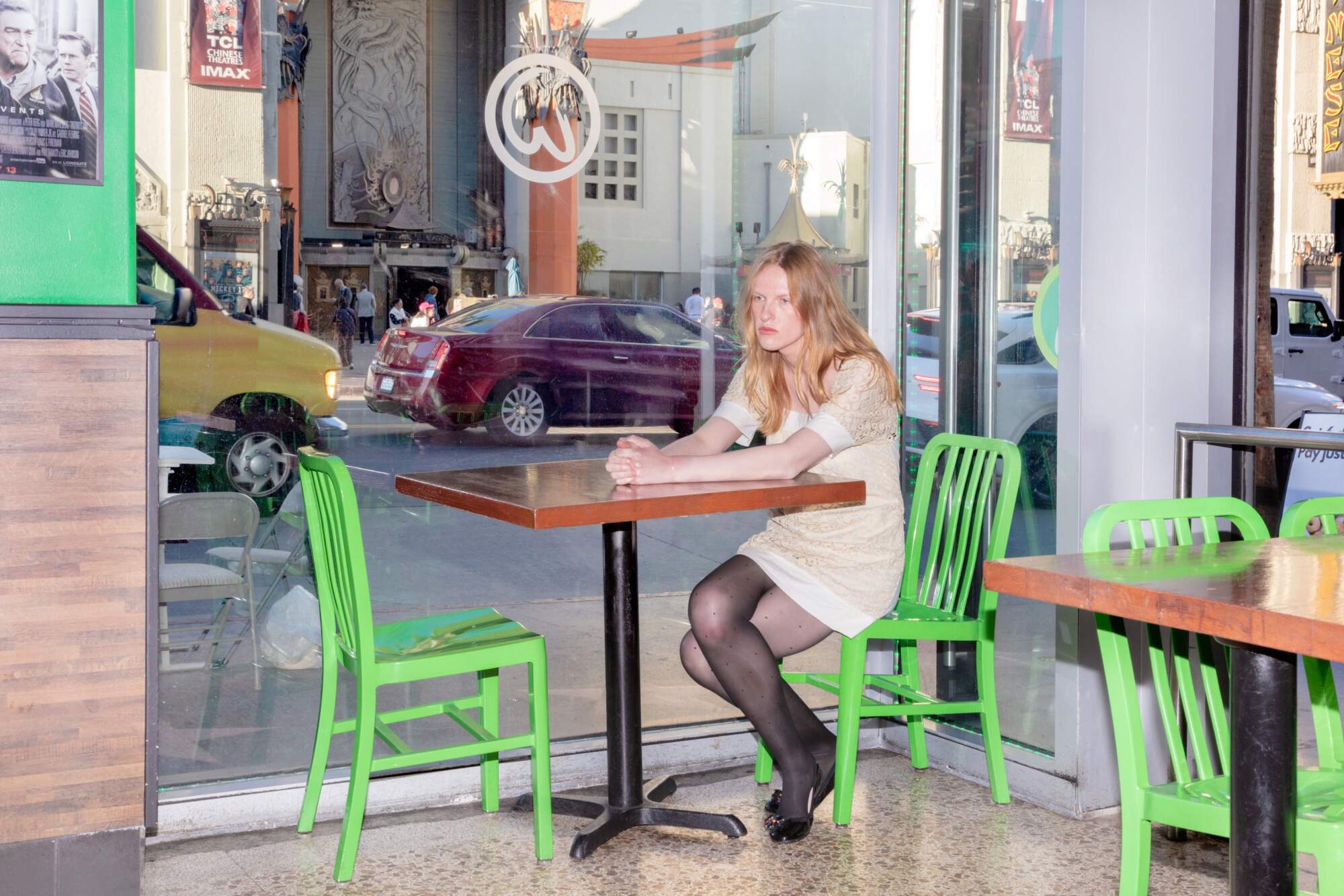
I hate to start a gig review with the polarising baggage of nepotism but given so much of my music writing leans narrative heavy – this story must start here: I wouldn’t know who Audrey Hobert was if not for Gracie Abrams. And perhaps the world would not know Gracie Abrams if not for Star Wars. It’s a layered web.
Much like the term influencer, nepotism has developed a particularly loaded connotation over the past decade. We’ve arrived at a point in history where public consciousness has peaked around A-List intergenerational stardom – everyone from Dakota Johnson, Lily Allen to Matty Healy grew up with industry connection. Inheritance is part of the marketing and subsequent internet fixation: we are consuming the lore of access alongside the work itself.
Then there is Hobert. Her father’s entertainment credits span Scrubs and Malcolm in The Middle. Her brother is an indie radio darling (Malcolm Todd) and before she began publishing her own music she had already racked up a bunch of songwriting credits on the Billboard Hot 100, general industry know-how and a bucketload of instagram followers, all via best friend Gracie Abrams. Success in all industries to some degree relies upon networks and visibility – entertainment is simply one where the machinery is well documented and visible to the public. I’m less of a fence sitter on nepotism and more of a realist – it is what it is.
All that to say – Hobert’s debut album (which was always going to sell well for aforementioned reasons) was one I streamed heavily in 2025.
I stay somewhat hyper aware of contemporary pop, particularly in America and the UK. Not just through virtue of this being professionally relevant, but also as a fan I think it has changed dramatically over my lifetime. To say the scene is saturated would be an understatement. Nevertheless, Hobert was unusual – so I paid attention.
On paper of course, she catered neatly to my tastes: clever lyricism, stream-of-consciousness confessionals, explorative hooks that wander slightly sideways before resolving into something catchy. I had seen vignettes on instagram of Hobert singing over the years while following Abrams’ career so I had a sense of her writing chops. The danger of being so adjacent to a popstar best friend is that you become synonymous with their craft and style. Did I assume Hobert’s debut would be closely linked to Abrams’ style? Yes. Was I wrong? Yes.
The album itself is a neat debut. It’s theatrical, funny and generally quirky by “pop” standards. Not in an experimental pop way, moreso in the way Hobert writes and holds herself. It’s not glossy neatly packaged pop, and while it is a bit repetitive melodically (the way all debuts generally are) there is a bizarrely refreshing honesty that is almost jarring.
Overly specific lyrics like “Touching my leg, you don’t have a headboard / Do that again, I think that I want more If this is it, then what is it all for? Let’s make it quick, then I’m leaving out the front door,” are examples of just how on the nose some of the biographical details are. I read a fair critique that the specificity is probably the only let down of the record, but it is also part of the charm and why so many people on the internet found themselves listening even if they didn’t know Hobert’s backstory.
Given the record is conversational and verbose I didn’t expect the live show to be some soaring vocal performance. In fact I wasn’t quite sure how a live show would work because Hobert only has 35 minutes of original music. By contrast, her built-in fan base meant she was selling out mid sized venues already. Before the show my friend and I discuss how this will be handled – a long encore? A cover section? Turns out – it’s just a short show. Respect.
Hobert is a theatre kid. Or at least that’s how it comes across. She comes out on stage in a big trench coat, stilts and one of those plastic facial disguises from the 90s with a big nose, glasses and moustache.
She plays the album almost in order. Second song Drive feels like it needs to be at least 2 minutes longer based on how the crowd reacts and when she pulls out the acoustic guitar on Wet Hair she finally says “welcome to my show – this is my favourite part.” She does Don’t Go Back To His Ass into Bowling Alley, before which she shares “this song is about being nervous.” So much of Hobert’s discography is about slightly uncomfortable and often unnamed emotions.
The trench coat comes off, revealing a short black dress with long sleeves. Soon she is running back and forth on stage to crowd favourite Thirst Trap, “I’m taking thirst traps in the mirror in my room, I think I look bad so I change the lighting,” is yelled from the audience and she lowers the mic to let the room sing: “I once read that some people’s beauty can’t be captured / and he’ll be sorry, happy ever after.”
She does this quite a bit throughout – partly to indulge the audience, partly, perhaps, out of necessity. While she is an effusive and vibrant performer – she’s not a disciplined vocalist (nor does she claim to be). The challenge of writing such densely wordy songs and then putting on a theatrical spectacle is that it will leave you breathless. Perhaps that will improve with time. For now it barely matters. Nobody seems to attend an Audrey Hobert show in search of technical precision.
What makes Hobert compelling is her willingness to create a brand of pop that is a bit weird. If like me, you were also held hostage in the nightmare that was Riverdale in the year 2016, Jughead’s instantly meme-able line: “in case you haven’t noticed, I’m weird. I’m a weirdo. I don’t fit in. I don’t want to fit in,” quite neatly applies to Hobert’s place within the pop ecosystem.
Melodically though, she’s sitting right in a sweet infectious earworm pocket. Nothing too outlandish and very accessible. Beneath all the energy and offbeat humour are extremely efficient pop structures. Hobert’s instincts as a songwriter are far more sophisticated than her limited years of experience would suggest – she only really started making music seriously a few years ago. By her own admission she began writing, happened to be best friends with a popstar who already had found a groove – Hobert proved to be good at it and subsequently she found a brand new career. Is that the bit where I should link back to nepotism? It’s complicated because I do think Hobert is a refreshing addition to music – for once, we have someone in mainstream pop who is not pushing an image, she is pushing a feeling. Would she have managed to break through without her industry upbringing and friend connections? Maybe. LA is weird like that. But it probably would have taken her a lot longer and we would have skipped her insight into the 20-something experience which would have been a shame – her lyrical content outlaps all her contemporaries.
She gets almost emotional introducing her song Phoebe. It is one of the strongest performances of the night and contains the excellent line “cause why else would you want me? I think I’ve got a fucked-up face.” The acoustic guitar is back and she shares how this one took her a long time to finish. Through the show she speaks to the audience but she’s never long winded or hyperbolic.
In many ways this is a comedy album dressed up as a satirical take on being a pop star. It implies it in the title – Who’s the Clown? So while Hobert isn’t the world’s best vocalist she has carved out a deeply authentic niche that is pushing pop music in a direction I think it needs: fun. She is dry and goofy and even though parts of the show feel a bit clunky because the vocals are a bit all over the place – it somehow still lands because the songs are good and everyone is having fun. Side note: her band is great which suggests to me that since this is her first album tour, things will improve.
And so eventually we get to the last few songs of the 35 minute record. Silver Jubilee and Shooting Star are two excellently written pop songs and some of my favourites from the record – so I was quietly disappointed they didn’t quite stack up live. Leaving that aside, what Hobert does well is hold a crowd. For someone so new to live performances, she is an incredibly engaging performer. Regardless of the ebbs and flows with the sound, for the hour she is on stage she manages to keep every single person transfixed.
Finally, we got to experience the famed no-phones encore. It’s become enough of a thing that she barely has to provide a preamble for this to occur. She doesn’t leave the stage and instead just plays her hit and lead single Sue Me again – everyone puts their phones down (if you wanted a video, you probably got it when she played it the first time) and we dance.
I grew up in the era of concerts where cameras and camera phones existed. I used to take a little pink digital camera into the mosh pit for my first gigs. By the time I was 21 it was commonplace to see a sea of iPhones. Don’t get me wrong, I love a good concert video – I rewatch them when I write up reviews and revisit old gigs all the time – sue me. Even I think it’s too much sometimes, so this was a memory that will stay with me. Seeing people fully let loose and not be bothered about waving their arms in somebody’s field of vision because nobody was really looking at the stage – everyone was just dancing.
Moments like that feel fleeting these days so I am grateful Hobert understands her power. The tour was titled Stairway to Stardom. For all the critics – she may have had a leg up to the first step, but thankfully she seems to be forging a slightly stranger path ahead.